Teen Innovators Win IEEE Presidents' Scholarship with Groundbreaking Assistive Tech and Robotics Projects
Published: August 19, 2026
Bridging the Gap in Assistive Technology Through DIY Engineering
According to data from the World Health Organization, more than one billion people worldwide live with some form of physical or cognitive disability. For many of these individuals, challenges with mobility and motor control significantly restrict their daily independence. While commercial assistive technologies exist, their prohibitive costs often put them far out of reach for average families.
At the Regeneron International Science and Engineering Fair (ISEF) held in Phoenix, Arizona, three high school developers demonstrated how consumer-grade microcontrollers, open-source machine learning, and creative mechanical designs can revolutionize assistive care. Recognizing their achievements, IEEE President Mary Ellen Randall awarded these young innovators the prestigious IEEE Presidents' Scholarship. Their projects prove that complex biomedical and robotic solutions can be built affordably using accessible, garage-lab methodologies.
1. Project "Tonguage": A Computer-Vision HMI for Hands-Free Control
For individuals living with severe motor impairments, such as quadriplegia, interacting with computers or operating motorized wheelchairs is an ongoing challenge. High school sophomore Hollie Tang developed Tonguage, a non-invasive, vision-based human-machine interface (HMI) designed to restore digital and physical autonomy.
Rather than relying on expensive eye-tracking systems or invasive implants, Tonguage processes real-time video signals from a standard, low-cost laptop webcam. The system maps the user\'s face and tracks subtle movements of the tongue and eyes. Tang\'s software uses these inputs to emulate peripheral devices:
- Directional Cursor Control: The physical position and motion vectors of the user\'s tongue act as an analog joystick.
- Click Interactions: Intentional eye blinks are filtered and translated into left- and right-mouse clicks.
To make the system viable for real-world applications like wheelchair navigation, safety was a paramount design requirement. Tang implemented an active face-tracking filter that locks onto the primary user. If a bystander moves into the camera\'s field of view, the system ignores the secondary facial landmarks, preventing erratic or dangerous navigation commands. By optimizing the computer-vision pipeline to run on consumer hardware, Tang ensured her solution remains highly accessible regardless of a user\'s socioeconomic status.
2. NeuroGait: The $276 Mind-Controlled Exoskeleton
Commercial lower-limb exoskeletons are marvels of modern engineering, but their retail prices generally range from $40,000 to over $100,000. High school junior Partap Sidhu set out to disrupt this market by designing NeuroGait, a functional, brain-controlled exoskeleton built for a mere $276.
The engineering behind NeuroGait is exceptionally sophisticated. The system relies on predicting movement before it physically occurs by monitoring the brain\'s electrical activity. Here is how the signal chain operates:
- Signal Acquisition: A custom-built electroencephalogram (EEG) headset monitors the motor cortex, searching specifically for the Bereitschaftspotential (BP), or readiness potential. This faint electrical signal manifests in the brain roughly one to two seconds before a person consciously initiates movement.
- Pattern Recognition: The raw EEG data is fed into a localized Convolutional Neural Network (CNN). In testing, the CNN achieved an astonishing 99.9% accuracy in classifying motor intentions.
- Actuation: Once a movement intention is classified, the system sends a command to the physical exoskeleton.
To avoid the weight and rigidity of heavy electric motors, Sidhu opted for soft robotics. NeuroGait utilizes custom-designed pneumatic artificial muscles (PAMs). These 3D-printed actuators contract when pressurized, closely mimicking the natural compliance and biomechanics of human muscle tissue. Across 500 trials, the end-to-end system maintained a physical control accuracy of 95.2%, offering a glimpse into the future of low-cost neuro-prosthetics.
3. Math Into Motion: A Rugged Search-and-Rescue Hexapod
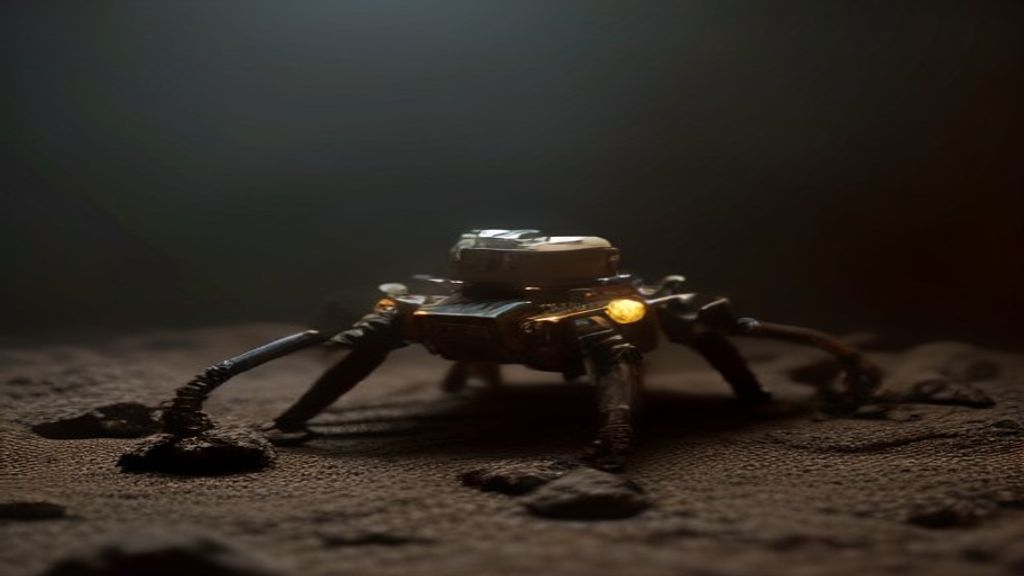
When natural disasters strike, navigating collapsed buildings or unstable debris is highly hazardous for human rescue teams and conventional wheeled rovers. Sophomore Calvin Shang Hung addressed this challenge with his project, Math Into Motion: Robotic Hexapod for Hazardous Environments.
Hung designed a six-legged robot capable of maintaining a highly stable tripod gait, where three legs remain firmly on the ground while the other three transition forward. To coordinate the complex movement of eighteen individual joints (three per leg), Hung taught himself advanced mathematical models and embedded programming:
- Inverse Kinematics (IK): Computes the precise angular rotation required for each joint servo to position the foot at a specific coordinate in 3D space.
- Linear Interpolation: Smoothes out the transitions between steps, reducing physical vibration and mechanical stress.
- Euclidean Transformations: Translates global directional vectors into localized leg movements, allowing the robot to change directions seamlessly regardless of its chassis orientation.
The journey was not without hardware setbacks. During development, a catastrophic short circuit destroyed the third version of his custom printed circuit board (PCB). Instead of abandoning the project, Hung simplified the system architecture, redesigned the PCB power plane, and successfully built a fourth version that walked flawlessly. The hexapod is designed to carry payload sensors to locate survivors or transport medicine in active disaster zones.
Key Takeaways for Embedded Developers and Makers
The achievements of these three student developers highlight a profound shift in the electronics and robotics landscapes. Advanced features like computer-vision interfaces, convolutional neural networks for biosignal analysis, and multi-axis inverse kinematics are no longer restricted to university laboratories.
By leveraging rapid prototyping tools, 3D printing, and accessible programming platforms, developers of all ages can design highly impactful, empathetic technological solutions that solve real-world human problems.
About EDATA SL
EDATA SL shares practical electronics,
embedded systems,
Arduino,
ESP32,
Raspberry Pi,
IoT,
repair guides,
DIY projects
and technical news for engineers,
students and makers.
Original news rewritten with AI for educational purposes.